This is our old blog. It hasn't been active since 2011. Please see the link above for our current blog or click the logo above to see all of the great data and content on this site.

Layups: Blogger Q&A with Charles Barkley

Posted by Neil Paine on June 11, 2010

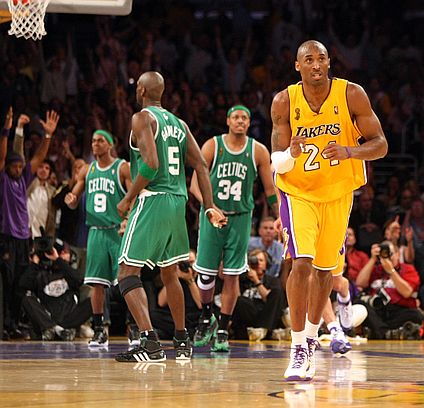
This week, I was invited back to participate in NBA.com's Blogger Q&A series again. The guest was Charles Barkley, an inner-circle Hall of Famer and one of my personal favorite players (and announcers) of all time, so I asked Charles to weigh in on the Kobe-Pau Finals MVP debate (which may have been a bit premature in retrospect, as the Celts drew even in the series last night). As always, thanks are in order to the NBA and YouCast Corp. for putting together this opportunity.

Other NBA.com Content:

Sir Charles on NBA.com
TNT Crew A-Team Video
Game 1 Mini Movie
Game 2 Mini Movie
Game 3 Mini Movie
Lakers/Celtics Top 10 Moments

Posted in A Word From Our Sponsors, Layups, Playoffs | 6 Comments »

Alpha Dogs, Second Bananas, and the Finals MVP

Posted by Neil Paine on June 10, 2010

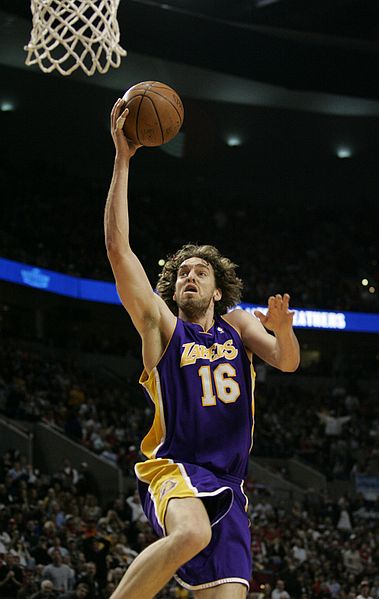
During yesterday's Kobe Bryant discussion, an interesting point was raised about just what it will take for Laker second banana Pau Gasol to be named Finals MVP this season. My rhetorical question on the matter was this:

"I wonder if an established best player on a team has a sort of "incumbent effect" when it comes to Finals MVPs? In other words, how badly would Kobe have to play -- and how well would Gasol have to play -- for Kobe not to be named Finals MVP? [...] What kind of handicap does a 2nd banana have when trying to overcome the Alpha Dog for Finals MVP?"

Today I want to look at this phenomenon statistically, and see how often the winning team's agreed-upon "best player" won Finals MVP honors, how the second bananas' numbers compared to the Alpha Dogs' during the Finals, and hopefully determine what kind of handicap a non-"Alpha Dog " faces when vying for the award.

Read the rest of this entry »

Posted in Analysis, History, Playoffs | 31 Comments »

Layups: Clutch Players and Wall Street Bankers

Posted by Neil Paine on June 9, 2010

In this Huffington Post piece, MIT Management Professor Dan Ariely looked at two high-pressure jobs -- Wall Street Bankers and NBA basketball players -- to see if some people actually respond positively to stress:

"With the help of Duke University men's basketball Coach Mike Krzyzewski ("Coach K"), we got a group of professional coaches to identify clutch players in the NBA (the coaches agreed, to a large extent, about who is and who is not a clutch player). Next, we watched videos of the twenty most crucial games for each clutch player in an entire NBA season (by most crucial, we meant that the score difference at the end of the game did not exceed three points). For each of those games, we measured how many points the clutch players had shot in the last five minutes of the first half of each game, when pressure was relatively low. Then we compared that number to the number of points scored during the last five minutes of the game, when the outcome was hanging by a thread and stress was at its peak. We also noted the same measures for all the other "nonclutch" players who were playing in the same games."

Their initial finding?

"We found that the non-clutch players scored more or less the same in the low-stress and high-stress moments, whereas there was actually a substantial improvement for clutch players during the last five minutes of the games. So far it looked good for the clutch players and, by analogy, the bankers, as it seemed that some highly qualified people could, in fact, perform better under pressure."

However, upon further inspection, they found that the "clutch players" in the study didn't shoot better in the last 5 minutes... they just shot more. To use the Wall Street analogy, they knew they had to do something to justify their mystique and high salaries, so they make it look like work was getting done, even if they weren't necessarily being truly productive.

Now, creating shots in and of itself is a skill, and that's certainly what the study's clutch players did in the final 5 minutes. However, those players already proved they could create at a high level in ordinary situations, so it's difficult to imagine that creating even more shots in minutes 44-48 is so much tougher than in minutes 1-43, that only the special clutch players can do it in those closing sequences. And remember, they're not even making many of the extra shots, they're just taking them.

I clearly believe in a usage-efficiency trade-off, and in the value of creating shots, but theoretically the clutch players were supposed to be able to increase their efficiency in crunch time as well (or at least hold it constant), not just increase their usage.

Posted in Layups | 6 Comments »

LakerTracker 2010: Games 1-3

Posted by Neil Paine on June 9, 2010

If you listened to any of the hype in the days leading up to Game 1 of the Finals, you know that this Lakers-Celtics series was going to be seen as a referendum on two things: how much Kobe Bryant (and the Lakers as a team) have improved since 2008, and which player is better in the Kobe-LeBron debate. Conveniently for the casual fan, the common opponent in all three cases (Lakers-Celts 2008, Celts-Cavs 2010, & Lakers-Celts 2010) is the Boston Celtics, a team that -- superficially, at least -- has changed very little in the past few years, making for an easy and seemingly valid measuring stick.
I won't debate the validity of this assumption any more than to point out that more has changed for the Celtics since 2008 than meets the eye. But say for the purposes of argument that the basic premise is valid, that you can straight-up compare Kobe '08, Kobe '10, and LeBron '10 on the basis of their performance against a common playoff foe... Who looks better after 3 games?

Read the rest of this entry »

Posted in Analysis, Playoffs | 54 Comments »

Which Games Are the Most Important In a 7-Game Series?

Posted by Neil Paine on June 8, 2010

A few weeks ago, I looked at various players' career performances in "crucial games", which I defined as: "Game 3 or later in a 7-game series; Conference Semifinals or later; series tied, within 1 game either way, or an elimination game for the trailing team". But while that's a nice working definition, it's certainly far from universal; for instance, one commenter pointed out that an elimination game when down 3-0 isn't very "crucial" at all, because even if you win, it doesn't really do a lot to change the outcome of the series.

Now, I had been operating under the assumption that you still feel pressure as a player even when facing an insurmountable deficit (maybe you even feel the most pressure under those circumstances), but I can see where performing well in that kind of game doesn't really carry the same weight as the same performance in, say, a Game 7. It's a bit like that old criticism of Alex Rodriguez -- he only hits home runs when the score is lopsided (that isn't true, by the way, but it was an actual criticism they lobbed at A-Rod for a while before the Yankees won a World Series with him). A solo HR always counts for exactly 1 run, of course, but if you look at Win Probability Added, that HR can take on wildly different win values depending on the situation. The same goes for wins in a 7-game series -- winning Game 5 when it's tied 2-2 is more important than winning Game 5 when you're down 3-1.

Read the rest of this entry »

Posted in Analysis, Playoffs, Statgeekery | 24 Comments »

Ray Allen’s Hot Streak

Posted by Neil Paine on June 7, 2010

In case you missed last night's game, Ray Allen went crazy from beyond the arc in the first half, knocking down his first seven 3-point shots of the contest. As Henry Abbott notes, Allen is a career 40% shooter from beyond the arc, on 6678 career attempts. So Henry asks:

"If you hit 40% of the time, and take 6,678 shots, how often would you end up with seven or more makes in a row?

Does Allen do that more often than you'd expect? (Bring on your probabilities!) If the answer is yes, then let's talk about the hot hand. But if the answer is no, well then let's appreciate this is the kind of night good shooters have sometimes, even without the supernatural."

Let's address the first question -- on average, how many runs of 7 straight 3-pointers would you expect a Ray Allen-like career (40% shooter, 6678 shots) to contain? And what's the probability that he would do it at least once in his career? Well, there's no easy way to set this up in equation form, because you have to account for the possibility of multiple sequences containing at least 7 consecutive makes, which would require some heavy-duty combinatorics. Instead, when confronted with a problem like this, I like to set up a Monte Carlo simulation and derive the probabilities by running a large number of trials (for other examples of posts where I did this, see here, here, here, here, and... well, you get the idea).

Read the rest of this entry »

Posted in Playoffs, Statgeekery | 27 Comments »

CBB: R.I.P. John Wooden (1910-2010)

Posted by Neil Paine on June 5, 2010

Note: This post was originally published at College Basketball Reference, S-R's brand-new College Hoops site, so when you're done reading, go over and check it out!

When the great John Wooden passed away on Friday at the age of 99, he left behind a staggering resume, arguably the most dominant winning legacy of any coach in any sport. Wooden won 10 championships at the helm of the UCLA Bruins during the 1960s and 70s, including an astonishing run of 7 straight titles from 1967-73; in the annals of basketball history, the only coach whose run of dominance is even on par with Wooden's is his NBA contemporary, Red Auerbach. Of course, Wooden was more than just a great coach -- and I'll leave the kind words about Wooden as a human being (of which there are many) to better writers than I -- but I did want to take a statistical look at just how amazing his coaching career was.

Exactly how impressive was Wooden's run in the 60s and early 70s? One measure of coaching greatness is the ability to resist the "pull of parity" -- since a .500 record relentlessly tugs at good teams and bad ones alike, drawing them inexorably toward the mean if given enough seasons, sustained greatness like Wooden's suggests a significant amount of skill. In the NCAA Tournament era (1939-present), we can quantify the pull of parity on any school thusly:

Expected Win % = 0.235 + 0.552*Previous Season Win %

This means that a team that won 88% of its games last year (for instance, Duke in 2010) should only expect to win 72% of its games next year, because parity wants to drag them toward .500. The assumption we're going to use is that if Duke ends up winning more than 72% of their games, it would be an indicator of Mike Krzyzewski's coaching skill.

So back to Coach Wooden... Here's his career coaching record, alongside his school's expected Win % every year, and the number of wins by which he exceeded that expectation:

Read the rest of this entry »

Posted in Analysis, History, NCAA | 10 Comments »

When Ray Allen Plays 30 Minutes…

Posted by Neil Paine on June 4, 2010

After last night's Laker rout, in which a foul-troubled Ray Allen only took the floor for 27 minutes, I wondered how important it was for the Celtics to have Allen play a substantial amount of time. Because while he may be the 3rd-best player on the team (4th-best if Garnett is anything like his vintage self), his ability to knock down huge threes has been indispensable to Boston over the past 3 years, especially in these playoffs.

To make a quick-and-dirty test on how important it was for Allen to play 30 or more minutes in a game, I created a sort of bastardized version of Adjusted Plus-Minus (using RS + playoff data in the "Big Three" era -- 2008-10) that predicts a team's homecourt-adjusted efficiency differential in every game based on whether or not any given player played at least 30 minutes or not in the game (a 48 minute game, that is -- the threshold was proportionally higher for OT games).

Controlling for the player's teammates and opponents in the game, we can get a rough estimate of what the impact in efficiency differential is on a given player playing 30 or more MPG. Here are the results for all 450 players who had a 30+ minute game in the past 3 years (except Lorenzen Wright, who had 1 such game and was dropped due to singularity issues).

Read the rest of this entry »

Posted in Analysis, Playoffs, Statgeekery | 9 Comments »

BBR Mailbag: The Most Offensively Balanced (and Imbalanced) NBA Finalists

Posted by Neil Paine on June 3, 2010

Today I have a mailbag question from our friend David Biderman at The Wall Street Journal:

Hey Neil,

I had an NBA playoffs question. I took a quick (really quick) glance at the Celtics, and the first thing that jumps out is how balanced their starting five was during the regular season. Is there any way to quantify how balanced a team is? If so, could we do this for NBA finals teams?

Absolutely; in fact, it's a concept I looked into a bit for these posts:

Spreading It Around
Championship Usage Patterns and “The Secret”
Championship Usage Patterns II
Championship Usage Patterns III: Regular-Season Teams Built For the Playoffs

However, I hadn't looked at NBA Finalists in particular yet, and I also would like to take this opportunity and try out a new metric to measure how balanced teams' starting lineups are.

The new metric (well, new to me at least) is called the Herfindahl-Hirschman Index (HHI), which measures how concentrated a market is among its firms. A monopolistic market will have a high HHI score, indicating that the majority of the market power rests with only a select few firms; conversely, a lower HHI score indicates a competitive market in which all firms have relatively equal shares. If you think of a basketball team as a market, you can apply this logic to a 5-man unit -- every player is working together to create points, but they're also "competing" against each other for touches and shots. A "monopolistic" lineup would be one where only one or two players take the majority of the possessions (think the 2000-02 Lakers with Shaq & Kobe), while a "competitive" lineup would be one where the offensive chances are distributed relatively evenly among the 5 players on the court.

Read the rest of this entry »

Posted in Analysis, BBR Mailbag, History, Statgeekery | 7 Comments »

NBA Finalists That Improved the Most In the Playoffs

Posted by Neil Paine on June 2, 2010

One of the biggest storylines of the 2010 playoffs has obviously been the Boston Celtics' totally unexpected postseason turnaround. From late December through the end of the regular season, the Celts were a very mediocre ballclub (literally average: they were .500 after Christmas), but in the playoffs they have looked -- and played -- like a completely different team, very nearly channeling the dominance of their 2008 championship squad. And lost amid the stories of Boston's playoff about-face has been the fact that the Lakers, owners of barely an above-average offense during the regular season, have morphed into an offensive juggernaut once again, as they were during the 2008 and 2009 regular seasons. In the history of the NBA, have any Finalists changed their identities more during the playoffs?

To answer that question, let's briefly go back to yesterday's post... There, I introduced a method of estimating team offensive and defensive ratings (points scored and allowed per 100 possessions) for years prior to 1974, which essentially opens up all of NBA history to us for studies like this (except 1951 -- unbelievably, they didn't even track rebounds that year). Today I want to use the same framework to see which Finalists most outperformed what we would have expected their playoff offensive & defensive ratings to be, given their regular-season numbers and the RS numbers of their playoff opponents.

Read the rest of this entry »

Posted in Analysis, History, Playoffs, Statgeekery | 5 Comments »