27th August 2010
 Here are some quick logistic regressions I ran between offensive/defensive efficiency (as measured by my 1951-2010 estimation equation) and whether or not a team won a championship...
The first regression is between regular-season offensive/defensive rating (relative to the league average) and championships won since 1951, the first year for which I can estimate possessions. The logistic equation to predict championship probability from RS efficiencies was:
p(C) ~ 1 / (1 + EXP(4.7267572 - (0.3988116 * Offense) + (0.612137 * Defense)))
From this equation, we would expect an average team during the Regular Season (0.0 on offense & defense) to have a 0.9% chance of winning an NBA title. If you increase offense to the following levels while keeping defense average, you see this pattern:
Read the rest of this entry »
Posted in Analysis, History, Playoffs, Statgeekery | 26 Comments »
22nd July 2010
In preparation for the updated "Who Rules the Top Defenses?" post I'm planning to write next week, I had to run the advanced stats for every player-game of the 2010 season (all 26,488 of them, including the playoffs), in addition to SRS scores for defenses only. Since I now have that data completed, today I thought I might as well make a post out of it and list the best opponent-adjusted offensive games of the 2010 campaign (according to offensive SPM, at least).
Read the rest of this entry »
Posted in Analysis, Playoffs, SRS, Statgeekery, Statistical +/- | 30 Comments »
15th July 2010
 One common media refrain when criticizing LeBron James' decision to "take his talents to South Beach" has been the idea that he left behind unfinished business in Cleveland. He and the Cavs posted consecutive 60+ win seasons in 2009 & 2010, each time securing the #1 record (and top playoff seed) in the Eastern Conference, but in both years Cleveland flamed out early. Many have used this as supposed "proof" of some character flaw on the part of James and his teammates, but what was the probability that this could have simply happened due to random chance alone?
To answer this question, I set up a very basic Monte Carlo simulation using the regular-season winning percentages of all playoff teams since the Cavs' first playoff appearance of the James era (2006). 10,000 times, I simulated the playoffs for each season, taking into account the postseason bracket & home-court advantage effects, and I recorded the team that won the Finals in each simulation. Here's how it broke down for each season:
Read the rest of this entry »
Posted in Analysis, Playoffs, Statgeekery, What If... | 117 Comments »
29th June 2010
There's a good discussion brewing in the comments of yesterday's thread, centering on whether the big disparity in FTA between L.A. and Boston during the NBA Finals was something we could have expected based on the two teams' season-long tendencies. Here are the facts we know right now:
- Los Angeles received far more free throw attempts per shot in the immediate basket area than Boston did.
- Per possession, Boston was the 3rd-most foul-prone team in the NBA during the season; L.A. was the 2nd-least foul-prone team.
Basically, Boston fouled a lot more than L.A. during the Finals, but they also fouled a lot against everybody, and L.A. was a team that didn't foul much at all. The question is whether the disparity during the Finals was bigger than we would expect based on the teams' known fouling tendencies. Fortunately, I can estimate a team's expected fouls per possession and free throw attempts per possession by comparing their regular-season rates to the league-average and multiplying by their opponent's regular-season rates:
BOS Expected PF/Poss = ((BOS PF/Poss) / (Lg Avg PF/Poss)) * (LAL Opponent PF/Poss)
Read the rest of this entry »
Posted in Analysis, Playoffs, Statgeekery | 69 Comments »
28th June 2010
Lots of great questions coming in the wake of Game Seven... As always, keep hitting me with your suggestions, either in the comments of the blog or at [email protected].
LakerTracker 2010: Final Kobe-vs-LeBron Numbers
This isn't technically a mailbag question, but it is the final piece in a series created by popular demand. In case you missed Part I & Part II, I've been tracking Kobe Bryant's performance in the Finals this year vs. LeBron James' performance against the same Celtics team in May, as well as Bryant's own performance against Boston in the 2008 Finals. Here are the final numbers:
Read the rest of this entry »
Posted in Analysis, BBR Mailbag, Playoffs | 29 Comments »
21st June 2010
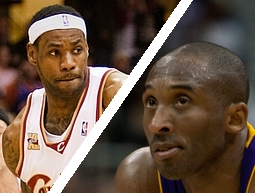 For those who missed the epic Kobe-LeBron thread over the weekend, here's a recap of a good back-and-forth between myself and a commenter named "Anon" (a far different Anon from the user who usually posts under that moniker, apparently)...
First off, I stated that if LeBron's teammates played as well vs. Boston as Kobe's did against the Celts, Cleveland would have advanced. In retrospect, I should have said "Cleveland would probably have advanced," since obviously there are no certainties, in life and least of all in sports, but the general point stands -- Cleveland's probability of beating Boston would have been higher had James' teammates given him a performance like Kobe's did against the same opponent. The justification for that statement is this:
"LeBron's SPM in the Cleveland-Boston series was +7.47. His team's efficiency differential was -5.8.
Kobe's SPM in the L.A.-Boston series was +7.45. His team's efficiency differential was +4.0.
Remember, 5 * the minute-weighted average of the SPMs of the individuals on a team must equal the team's efficiency differential.
This is what I mean when I say, 'if LeBron had gotten a Gasol-like performance from one of his teammates, Cleveland would have won.' Kobe and LeBron played at identical levels in their respective series vs. Boston. The only possible reason for their teams' disparate efficiency differentials must be the performances of their teammates."
I went on to show the cumulative stats for both teams during their respective series vs. Boston:
Read the rest of this entry »
Posted in Analysis, Playoffs, Statgeekery, Statistical +/- | 56 Comments »
18th June 2010
No commentary, just the numbers from the series...
Read the rest of this entry »
Posted in Data Dump, Playoffs | 247 Comments »
18th June 2010
Congratulations to the Lakers, they outlasted the Celtics in a very gritty, physical Game 7... They deserve to be champions after surviving that test. Also, congrats to the Celtics, whom no one thought would even make it to within a game of a championship. Both teams left it all on the floor here, and as an NBA fan that's all you can ask for. It was a great season, everybody, thanks in large part to our loyal readers and commenters. We couldn't do what we do without your support.
As a token of our appreciation, here are the final 2010 BBR Rankings:
Read the rest of this entry »
Posted in BBR Rankings, Playoffs | 10 Comments »
17th June 2010
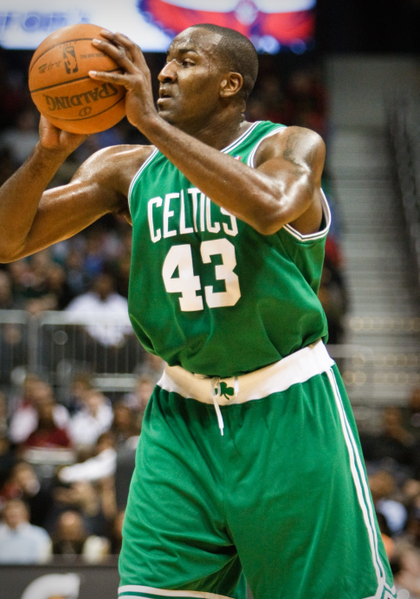 At first glance, Kendrick Perkins' knee injury early in Game 6 may seem like only a minor setback for the Boston Celtics -- after all, Perkins has scored just 8.5 PPG in the Big Three Era, and while his rebounding and defense are solid, he's never finished in the top 10 in RPG or garnered All-Defense honors. However, despite his lack of box score presence, Perkins has been highly important to the Celtics' chances this season: when he plays less than 22 minutes in a game, Boston is 5-8, including Tuesday's ugly loss and a similar beatdown suffered vs. Orlando in the Conference Finals when Perkins was limited by foul trouble.
We can really illustrate Perkins' hidden importance by looking at the Plus/Minus numbers. When Perkins was on the court for Boston this season, the Celtics outscored their opponents by 7.2 points per 100 possessions; when he wasn't playing, that number was only +0.2, a difference of -7 pts/100 poss. The same story has been true since Perkins became a regular starter in 2006-07: putting together a rudimentary game-by-game "with or without you" regression (similar to what I did in this post) between team HCA-adjusted PPG differential and whether or not a player played 17 minutes in the game (the MPG that usually indicates a "contributor"), Perkins shows up as adding +2.18 PPG to Boston's differential when he's a contributor vs. when he plays limited minutes or less.
Meanwhile, Perkins' Game 7 replacements, Rasheed Wallace and Glen Davis, don't fare nearly as well by the WOWOY metrics. Despite Davis' heroics in Game 4, he and Wallace have been Boston's two worst players by net on/off rating during the playoffs. Wallace has been particularly toxic for the Celtics all season -- the team played 5 pts/100 poss. worse when he was on the floor, as evidenced by his recurring appearance in the Celts' worst lineup combinations. Davis & Wallace look better by the 4-year WOWOY regression (Davis is +1.36, Wallace is +0.47), but neither has the ability to positively impact the game the way Perkins does. Without his presence, and playing on the road (home teams win Game 7 80% of the time), the Celtics appear to be in dire straits tonight.
Posted in Analysis, Playoffs, Statgeekery | 9 Comments »
16th June 2010
As a follow-up to this morning's post about historical 7-game series, here are some notes about the "shape" of this year's Finals...
First, what I mean by "shape" is the pattern of wins and losses by the home team in the series. For instance, the 2010 Finals look like this:
WLLWWW
In other words, the home team won Game 1, lost Games 2 & 3, and then won Games 4, 5, & 6. How often has that happened through the first 6 games of a 7-game series?
Read the rest of this entry »
Posted in Analysis, Just For Fun, Playoffs | 6 Comments »
